Commercial Kitchen Exhaust System Regulations in the UAE: What Every Restaurant Owner Must Know
Opening a restaurant, cafe, or cloud kitchen in the UAE means passing inspections before you serve your first customer. The commercial kitchen exhaust system regulations in the UAE are among the strictest checks you will face, and for good reason. A poorly designed system is a fire risk, a health risk, and a common reason for delayed trade licenses.
This guide covers the rules, the components your system must include, and the maintenance schedule that keeps you compliant.
Why Kitchen Ventilation Matters So Much in the UAE
Commercial cooking produces heat, smoke, grease vapor, moisture, and strong odors. In the UAE’s hot, humid climate, these problems are amplified. A poorly designed or neglected exhaust system can lead to:
- Serious fire hazards: Grease build up in hoods and ducts is a leading cause of restaurant fires worldwide. Once ignited, it acts as fuel.
- Fines and shutdowns: Dubai Municipality, Sharjah Municipality, and Civil Defense carry out strict inspections. Non compliance can mean heavy fines, delayed license approvals, or immediate closure.
- Unsafe working conditions: Excess heat and smoke cause fatigue, reduce efficiency, and increase the risk of heat stress for your kitchen team.
- Odour complaints: In shared buildings and dining districts, unmanaged cooking fumes can reach customers and neighbouring units, leading to complaints and legal warnings.
Key Regulatory Frameworks for Restaurant Kitchen Exhaust Systems in the UAE
Your kitchen design must meet both local authority requirements and recognized international standards:
- NFPA 96: The global benchmark for ventilation control and fire protection in commercial cooking operations.
- International Mechanical Code (IMC): Sets baseline requirements for air extraction and ductwork safety.
- Municipality health and safety codes: Issued by Dubai Municipality, Sharjah Municipality, and the Abu Dhabi Agriculture and Food Safety Authority (ADAFSA).
- UAE Civil Defence approval: Requires automatic fire suppression and fire rated materials over all heat producing cooking equipment.
Core Components of a Compliant Kitchen Exhaust System
1. Kitchen Exhaust Hoods (Canopies)
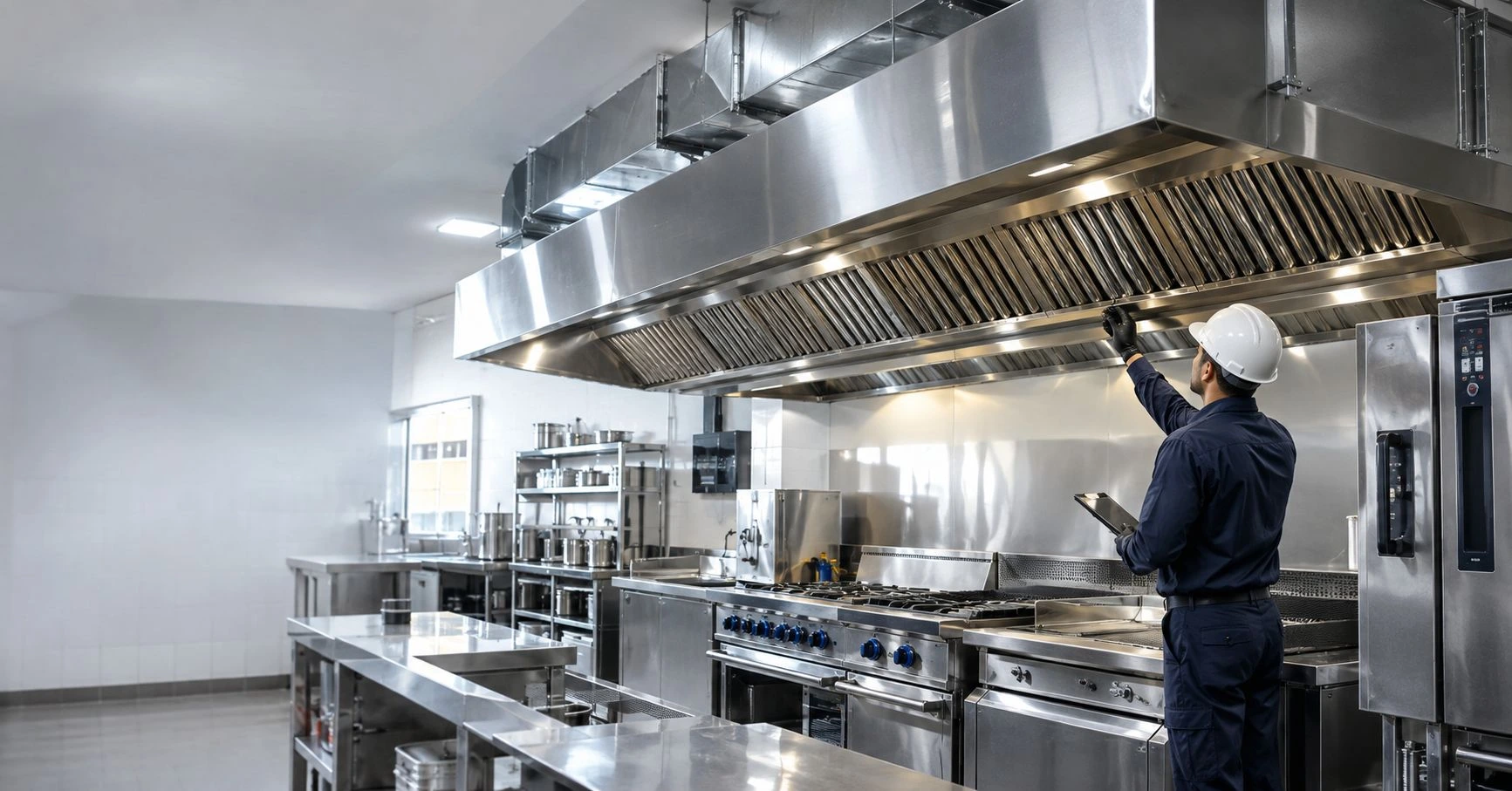
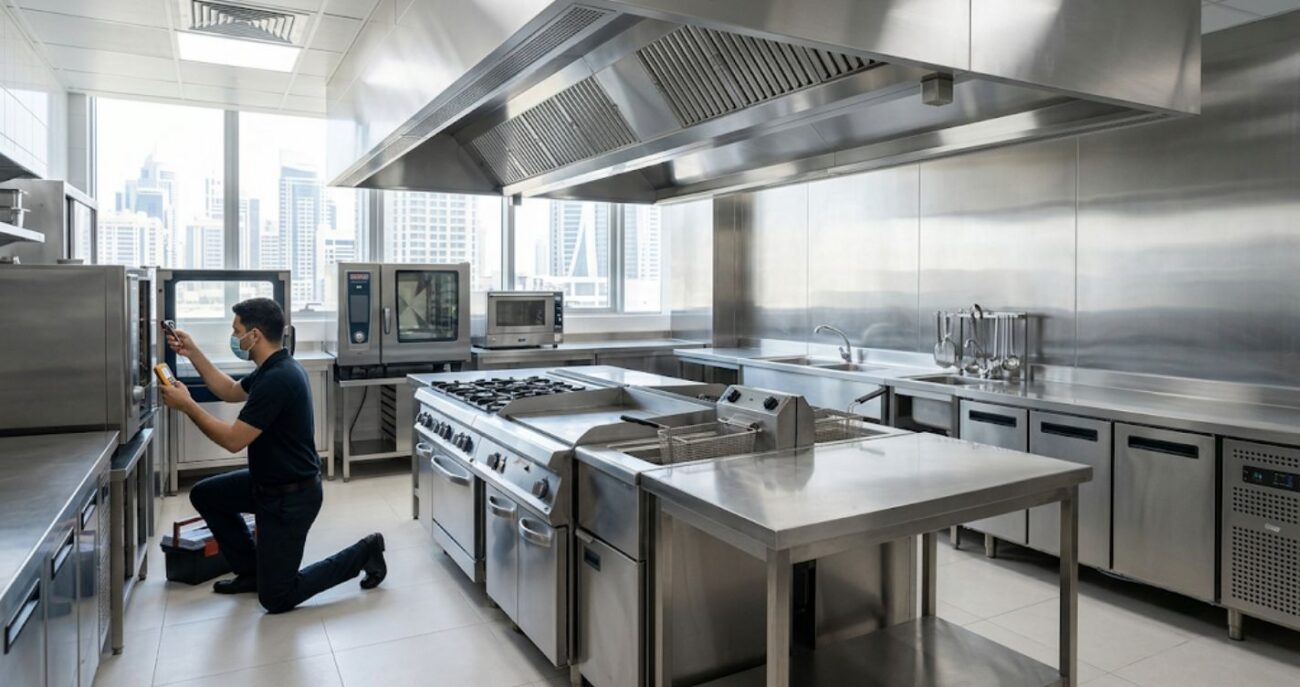
The hood is your first line of defence. It sits directly above cooking equipment and captures rising smoke, heat, and grease laden vapour.
- Material: High grade stainless steel (SS 304 or SS 316), at least 1.2 mm thick, to withstand heat and resist corrosion.
- Coverage: The hood should extend at least 15 to 30 cm beyond the appliance edges on all open sides.
- Baffle filters: Removable stainless steel baffle filters are required. They force air to change direction rapidly, so grease drops out into a collection tray. Mesh filters are not permitted in commercial kitchens because of the fire risk.
2. Fire Rated Ductwork
Ducts carry contaminated air from the hood to the outside.
- Construction: Liquid tight, continuously welded, in heavy gauge carbon steel or stainless steel.
- Fire protection: Ducts passing through building structures must be wrapped in fire-rated insulation or run in a fire rated Duct.
- Access doors: Leak proof access panels at every change of direction and at regular intervals along straight runs, so ducts can be inspected and degreased properly.
3. Civil Defense Approved Fire Suppression System
Every hood over gas or high heat appliances needs an integrated automatic fire suppression system, such as Ansul or an equivalent wet chemical system.
- Automatic gas shut off: When triggered, the system discharges suppressant onto the appliances and cuts the main gas supply immediately.
- Manual pull station: Installed along an exit route so staff can activate the system instantly in an emergency.
4. Fresh Air and Make Up Air (MUA) Systems
A common planning mistake is extracting air without replacing it. This creates negative pressure, which causes:
- Doors that slam or are hard to open
- Weak exhaust performance
- Hot outdoor air pulled in through gaps, overloading your air conditioning
A dedicated MUA unit draws in outdoor air, filters it, cools it slightly, and supplies it to the kitchen. It typically replaces around 80–90% of the exhausted volume.
5. Ecology Units (Air Purification and Odour Control)
In shopping malls and many urban developments across Dubai and Sharjah, releasing raw cooking smoke outside is not allowed. Ecology units typically combine:
- Electrostatic precipitators (ESP): Charge and capture fine grease particles and smoke.
- Activated carbon filters: Remove odours and volatile organic compounds (VOCs).
- UV-C treatment: Breaks down grease molecules and lingering smells before air is released.
Kitchen Exhaust Maintenance Checklist for Restaurant Managers
Compliance doesn’t end at installation. Follow this schedule to stay inspection ready
| Frequency | Maintenance Task |
| Daily | Remove, clean, and degrease baffle filters. Empty grease collection cups. |
| Weekly | Inspect hood interiors and wipe down visible stainless steel panels. |
| Monthly | Check fan belts and bearings, and read the pressure gauges on the fire suppression system. |
| Quarterly (every 3-6 months) | Book professional duct cleaning by specialists to remove internal grease. |
| Semi annually | Service ecology unit filters (ESP cell washing, carbon filter replacement) and test the fire suppression system for Civil Defence compliance. |
Frequently Asked Questions
Do all restaurants in the UAE need a civil defense approved exhaust system?
Any kitchen with gas or high heat cooking equipment needs a hood with an approved automatic fire suppression system. Requirements are confirmed during civil defense and municipality inspections.
What material should a commercial kitchen hood be made from?
Stainless steel, typically SS 304 or SS 316, at a minimum of 1.2 mm thickness.
Can I use mesh filters in my kitchen hood?
No. Baffle filters are the standard because mesh traps grease and increases fire risk.
How often should kitchen exhaust ducts be cleaned?
Professional duct cleaning is generally carried out every three to six months, depending on cooking volume and type.
Why do I need make up air?
Without it, your kitchen develops negative pressure, which weakens extraction and forces hot outdoor air inside.
Why Choose Al Tareeq Kitchen Equipment for Your Kitchen Ventilation?
Our team designs, manufactures, and supplies custom stainless steel kitchen hoods, ductwork, and complete ventilation setups for restaurants, hotels, cafes, bakeries, and cloud kitchens across Dubai, Sharjah, and the wider UAE.
- Our custom fabrication: Hoods built in our in-house workshop to match your exact kitchen footprint and equipment layout.
- Our compliance focus: Every system is built in line with UAE Civil Defence safety codes and local municipality standards.
- Our materials: Premium SS 304 food grade stainless steel for durability and easy cleaning.
- Made in UAE: Locally manufactured, so lead times are shorter, and after sales support is closer to you.
Ready to Install or Upgrade Your Kitchen Ventilation System?
Speak to our experts about compliant, custom built exhaust hoods and ventilation solutions. Call us on +971 52 367 4132 or WhatsApp us at +971 52 548 4062.

Add a review
Your email address will not be published. Required fields are marked *